---
title: "Modeling performance on a multiple choice exam"
image: ../social_cards/multiple_choice.png
author: "Andrew Gelman"
date: 2022-08-22
date-modified: today
date-format: iso
format:
html:
number-sections: true
code-copy: true
code-download: true
code-tools: true
bibliography: ../casestudies.bib
---
This notebook includes the code for the Bayesian Workflow book
Chapter 4 *Introduction to workflow: Modeling performance on a
multiple choice exam*.
## Introduction
We demonstrate with an example from Section 4.15 of
@Gelman-Vehtari:2024, assessing the grading of a multiple-choice test.
We analyze data from a 24-question final exam from a class of 32
students, where our applied goal is to check that the individual
test questions are doing a good job at discriminating between
poorly- and well-performing students. No external data are
available on the students, so we assess their abilities using their
total score on the exam.
Each item is a multiple choice question with 4 possible answers and
is scored either 1 (correct) or 0 (incorrect). The total scores
across the 24 question exam range from 12 to 21, with an average of
16. Across the questions the hardest question has 4 of the 32
students answering it correctly, while all students manage to
answer the easiest question correctly.
**Load packages**
```{python}
#| label: setup
#| include: true
#| cache: false
import warnings
import sys
sys.path.insert(0, '..')

import arviz as az
import bambi as bmb
import matplotlib.pyplot as plt
import numpy as np
import pandas as pd
import xarray as xr
from cmdstanpy import CmdStanModel, disable_logging
from scipy.special import expit
from scipy.stats import rankdata

from utils import print_stan
from plot_functions import plot_logit, plot_logit_grid, plot_logit_grid_2, plot_irt

warnings.filterwarnings("ignore", category=FutureWarning)
disable_logging()

az.style.use("arviz-variat")
az.rcParams["stats.ci_prob"] = 0.95
plt.rcParams["figure.dpi"] = 72
SEED = 123
np.random.seed(SEED)
```
## Stan models
Compile all Stan programs to use throughout the file
```{python}
#| label: compile-stan-models
logit_0 = CmdStanModel(stan_file="logit_0.stan")
logit_prior = CmdStanModel(stan_file="logit_prior.stan")
logit_guessing = CmdStanModel(stan_file="logit_guessing.stan")
logit_guessing_uncentered = CmdStanModel(stan_file="logit_guessing_uncentered.stan")
logit_threshold = CmdStanModel(stan_file="logit_threshold.stan")
logit_threshold_prior = CmdStanModel(stan_file="logit_threshold_prior.stan")
logit_guessing_multilevel = CmdStanModel(stan_file="logit_guessing_multilevel.stan")
logit_guessing_uncentered_multilevel = CmdStanModel(stan_file="logit_guessing_uncentered_multilevel.stan")
logit_guessing_multilevel_bivariate = CmdStanModel(stan_file="logit_guessing_multilevel_bivariate.stan")
logit_guessing_multilevel_bivariate_cholesky = CmdStanModel(stan_file="logit_guessing_multilevel_bivariate_cholesky.stan")
irt_guessing = CmdStanModel(stan_file="irt_guessing.stan")
irt_guessing_discrimination = CmdStanModel(stan_file="irt_guessing_discrimination.stan")
```
## Data
Read in data and construct score for each student
```{python}
responses = pd.read_csv("data/final_exam_responses.csv")
answers = pd.read_csv("data/final_exam_answers.csv")

J = len(responses)  # number of students
K = len(responses.columns)  # number of items

# Create correct answers array
correct = np.zeros((J, K), dtype=int)
for k in range(K):
    correct[:, k] = (responses.iloc[:, k] == answers.iloc[0, k]).astype(int)

score = np.sum(correct, axis=1)
item = np.sum(correct, axis=0)

# Summary statistics
print("Score summary:")
print(pd.Series(score).describe().round(2))
print("Item summary:")
print(pd.Series(item).describe().round(2))
```
```{python}
# Add jitter (random noise) to scores
score_jitt = score + np.random.uniform(-0.3, 0.3, J)

# Standardized scores
score_adj = (score - score.mean()) / score.std()

# Standardized jittered scores (using original score mean/std)
score_adj_jitt = (score_jitt - score.mean()) / score.std()

# Data for Stan (note: y should be a single column for the model)
data = {
    "J": J,
    "x": score.tolist(),
    "y": correct[:, 0].tolist()  # Select first item - change index as needed
}

# Item IDs as letters (only works if K <= 26)
item_id_0 = [chr(65 + j) for j in range(K)]  # A, B, C, ...
```
## Simple models
### Base model logit_0
```{python}
print_stan(logit_0)
dt = az.from_cmdstanpy(logit_0.sample(data=data, show_progress=False))
```
```{python}
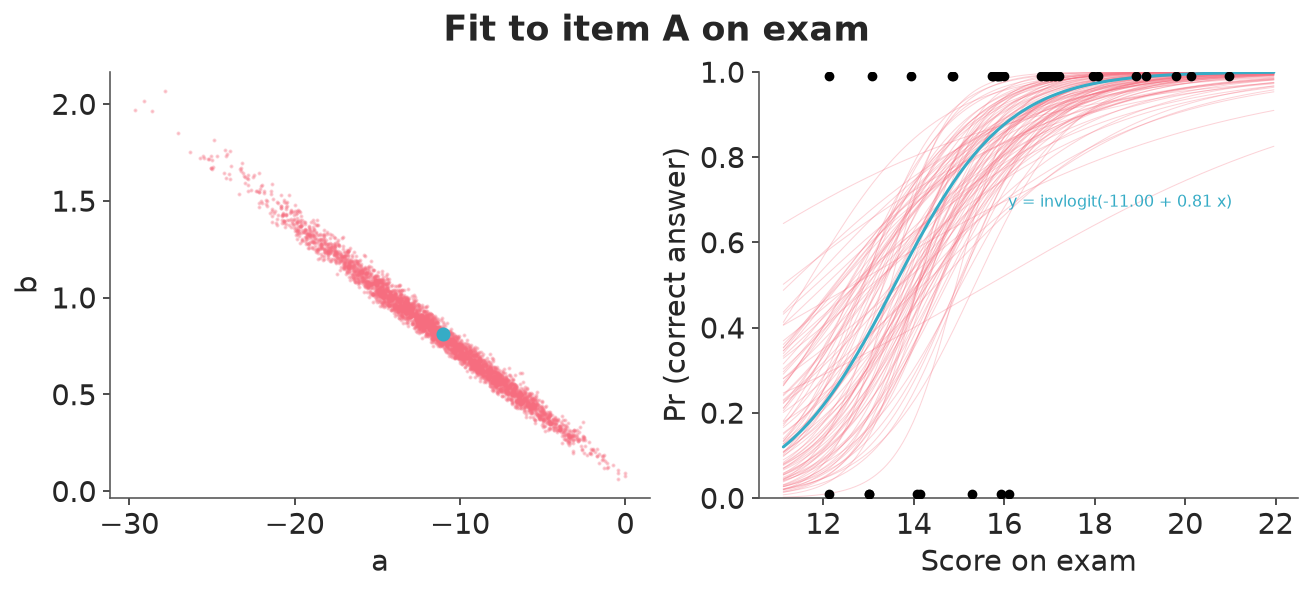
#| label: fig-final_exams_1
plot_logit(
    dt,
    "Fit to item A on exam",
    "Score on exam",
    correct[:, 0],
    score_jitt,
    guessprob=0
)
az.summary(dt)
```
### Add priors
```{python}
print_stan(logit_prior)
data = {
    "J": J,
    "x": score_adj.tolist(),
    "y": correct[:, 0].tolist(),
    "mu_a": 0, "sigma_a": 5,
    "mu_b": 0, "sigma_b": 5
}
dt = az.from_cmdstanpy(logit_prior.sample(data=data, show_progress=False))
```
```{python}
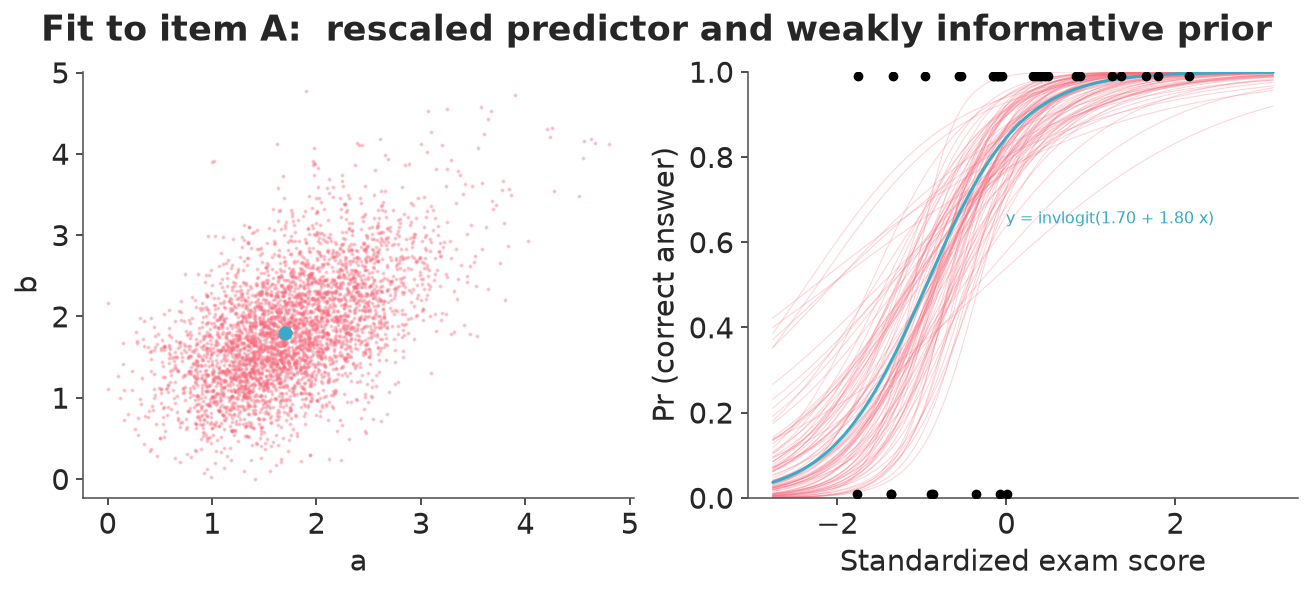
#| label: fig-final_exams_2
plot_logit(
    dt,
    "Fit to item A:  rescaled predictor and weakly informative prior",
    "Standardized exam score",
    correct[:, 0],
    score_adj_jitt,
    guessprob=0
)
az.summary(dt)
```
```{python}
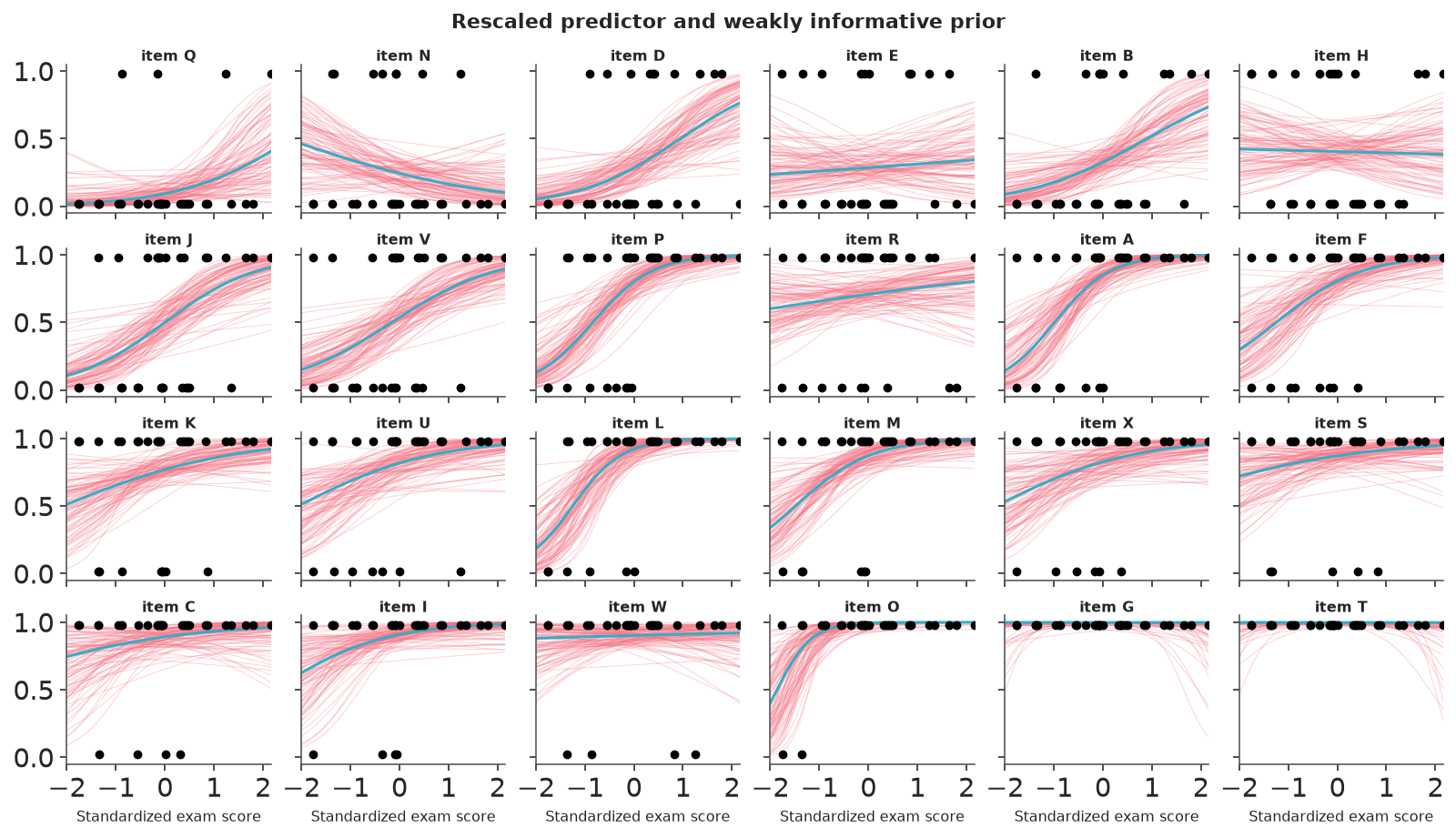
#| label: fig-final_exams_2b
plot_logit_grid(
    "Rescaled predictor and weakly informative prior",
    "Standardized exam score",
    logit_prior,
    {
        "J": data["J"],
        "x": score_adj.tolist(),
        "y": correct,
        "mu_a": 0, "sigma_a": 5,
        "mu_b": 0, "sigma_b": 5,
    },
    score_adj_jitt,
    item_id_0,
    guessprob=0
)
```
```{python}
data_ =  {
        "J": data["J"],
        "x": score_adj.tolist(),
        "y": correct[:, 6].tolist(),
        "mu_a": 0, "sigma_a": 5,
        "mu_b": 0, "sigma_b": 5
    }
dt = az.from_cmdstanpy(logit_prior.sample(data=data_, show_progress=False))
```
```{python}
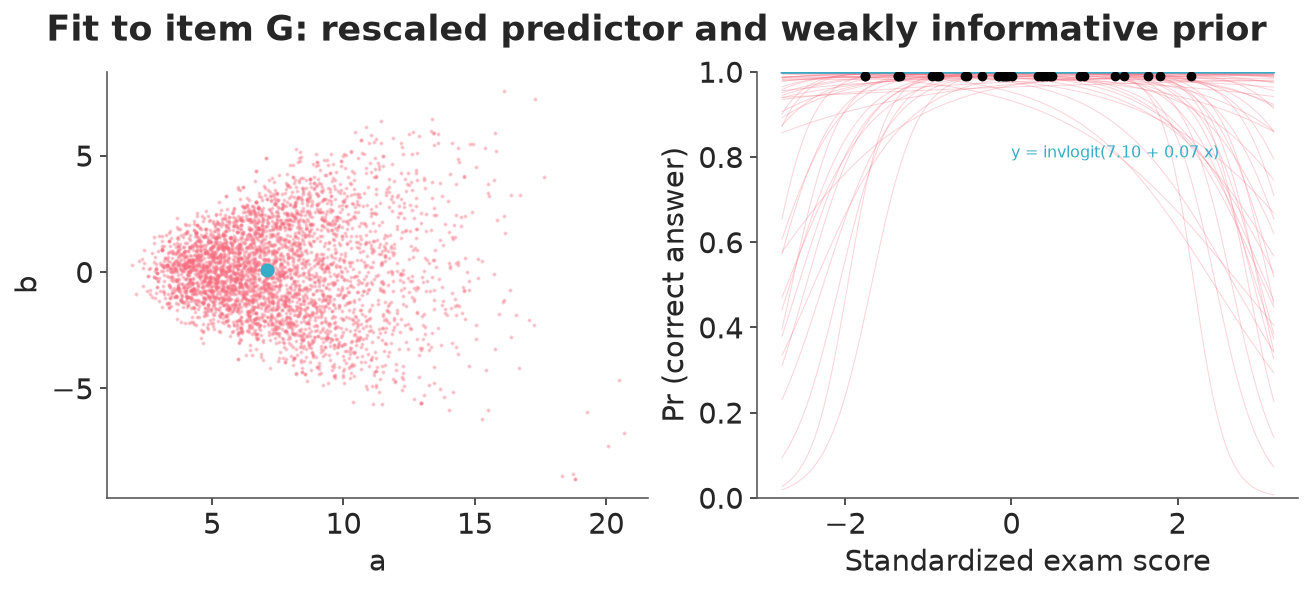
#| label: fig-final_exams_2_challenge
plot_logit(
    dt,
    "Fit to item G: rescaled predictor and weakly informative prior",
    "Standardized exam score",
    correct[:, 6],
    score_adj_jitt,
    guessprob=0
)
az.summary(dt)
```
### Fix the data problems
```{python}
answers.iloc[0, [4, 13, 16]] = ["d", "d", "c"]

# Recalculate correct answers
correct = np.zeros((J, K), dtype=int)
for k in range(K):
    correct[:, k] = (responses.iloc[:, k] == answers.iloc[0, k]).astype(int)

score = np.sum(correct, axis=1)
score_jitt = score + np.random.normal(0, 0.3, len(score))
score_adj = (score - score.mean()) / score.std()
score_adj_jitt = (score_jitt - score.mean()) / score.std()

data = {
    "J": J,
    "x": score.tolist(),
    "y": correct.tolist()
}

item_id = rankdata(np.sum(correct, axis=0), method='ordinal').astype(int)
```
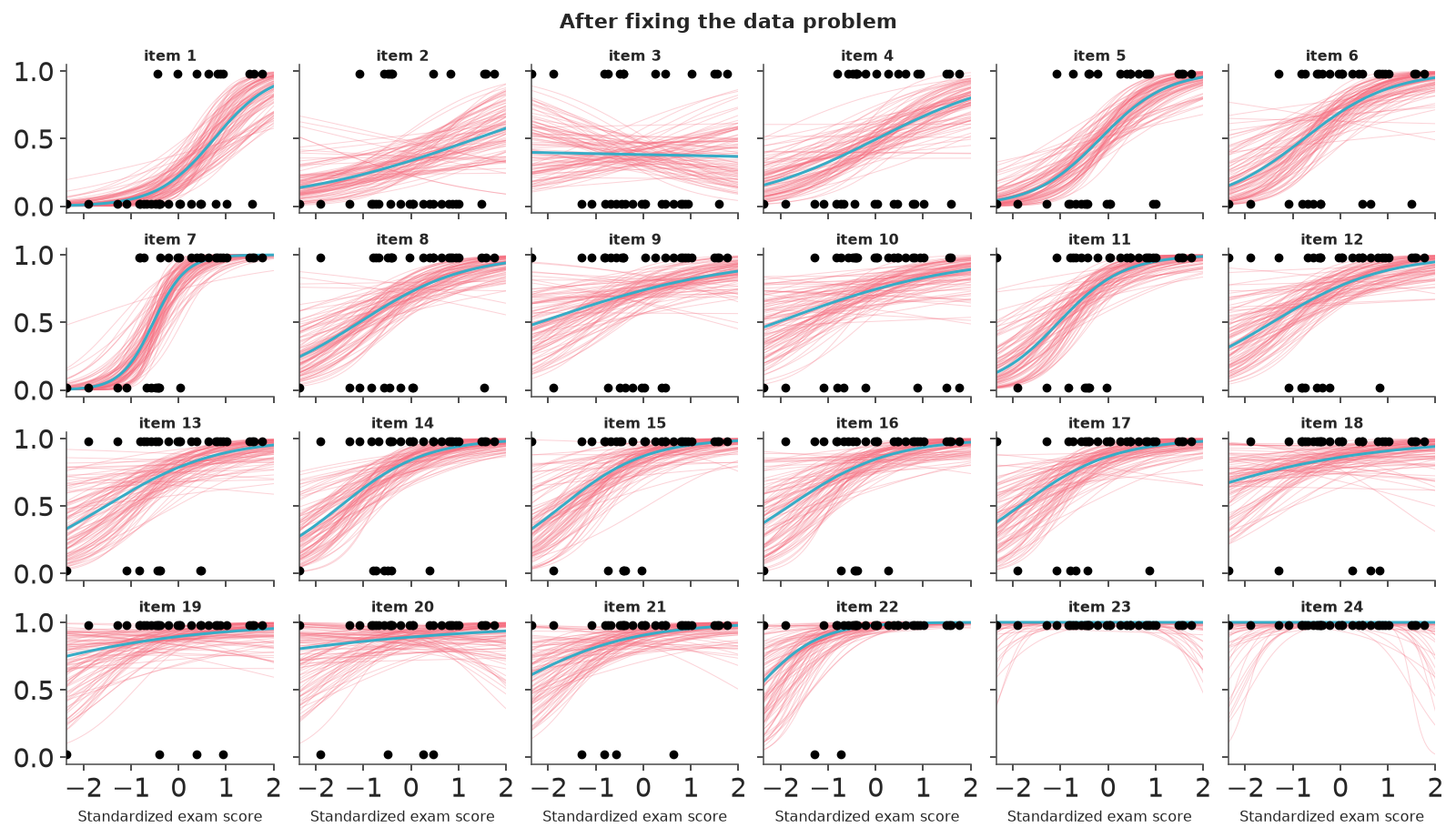
```{python}
#| label: fig-final_exams_3
_ = plot_logit_grid(
    "After fixing the data problem",
    "Standardized exam score",
    logit_prior,
    {
        "J": data["J"],
        "x": score_adj.tolist(),
        "y": correct,
        "mu_a": 0, "sigma_a": 5,
        "mu_b": 0, "sigma_b": 5
    },
    score_adj_jitt,
    item_id,
    guessprob=0
)
```
### Allow for guessing
```{python}
print_stan(logit_guessing)
```
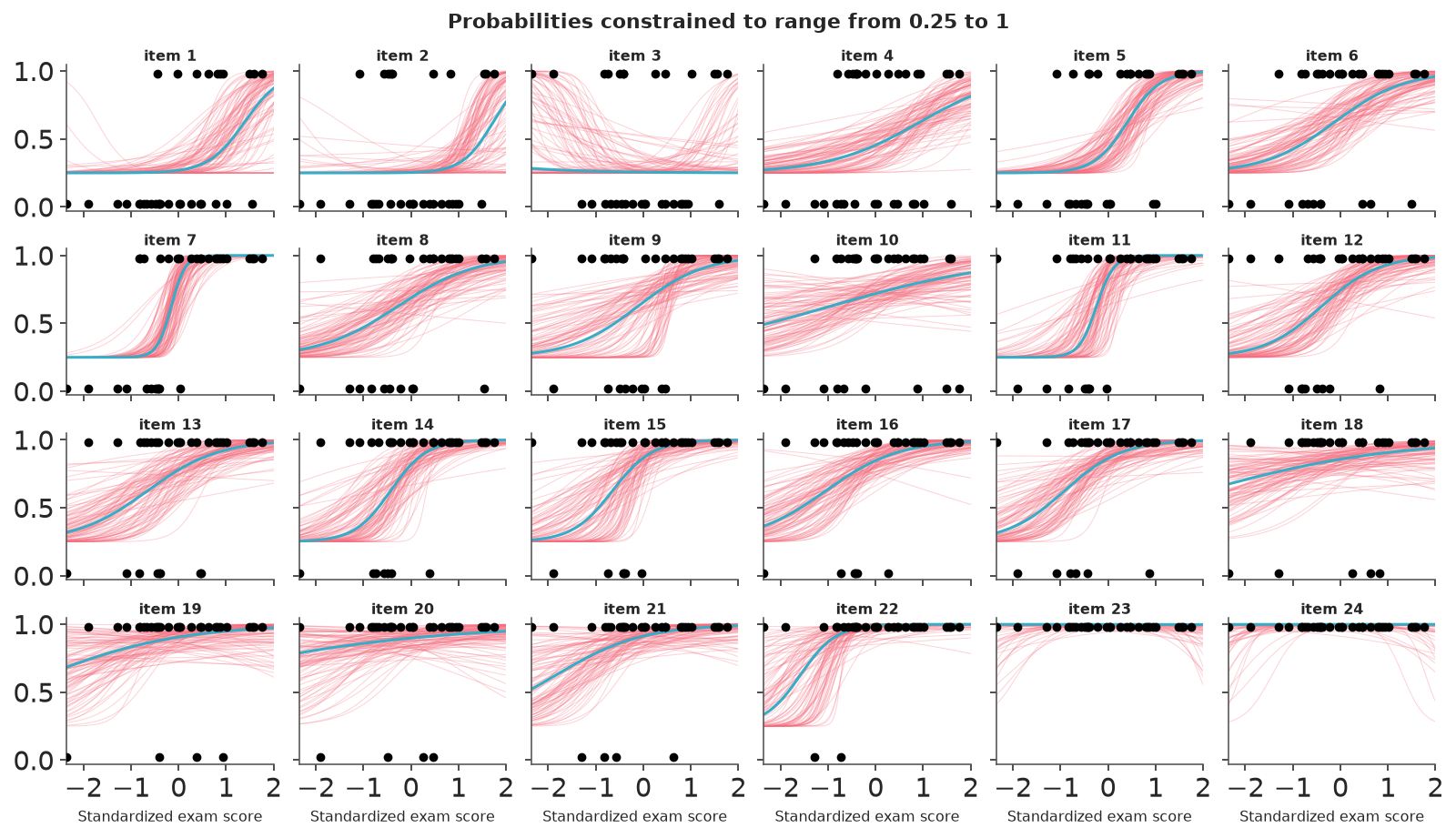
```{python}
#| label: fig-final_exams_4
_ = plot_logit_grid(
    "Probabilities constrained to range from 0.25 to 1",
    "Standardized exam score",
    logit_guessing,
    {
        "J": data["J"],
        "x": score_adj.tolist(),
        "y": correct,
        "mu_a": 0, "sigma_a": 5,
        "mu_b": 0, "sigma_b": 5
    },
    score_adj_jitt,
    item_id,
    guessprob=0.25
)
```
## Multilevel models
In preparation for multilevel model, create long dataset
```{python}
N = J * K
y = []
student = []
item = []

for j in range(J):
    for k in range(K):
        y.append(correct[j, k])
        student.append(j + 1)  # 1-indexed for Stan
        item.append(k + 1)      # 1-indexed for Stan

longdata = {
    "N": N,
    "J": J,
    "K": K,
    "student": student,
    "item": item,
    "y": y,
    "x": score_adj.tolist()
}

longdata_ = {
        **longdata,
        "mu_mu_a": 0, "sigma_mu_a": 5,
        "mu_mu_b": 0, "sigma_mu_b": 5,
        "mu_sigma_a": 5, "mu_sigma_b": 5
    }
```
### Multilevel model
```{python}
print_stan(logit_guessing_multilevel)
dt_5 = az.from_cmdstanpy(logit_guessing_multilevel.sample(data=longdata_, show_progress=False))
```
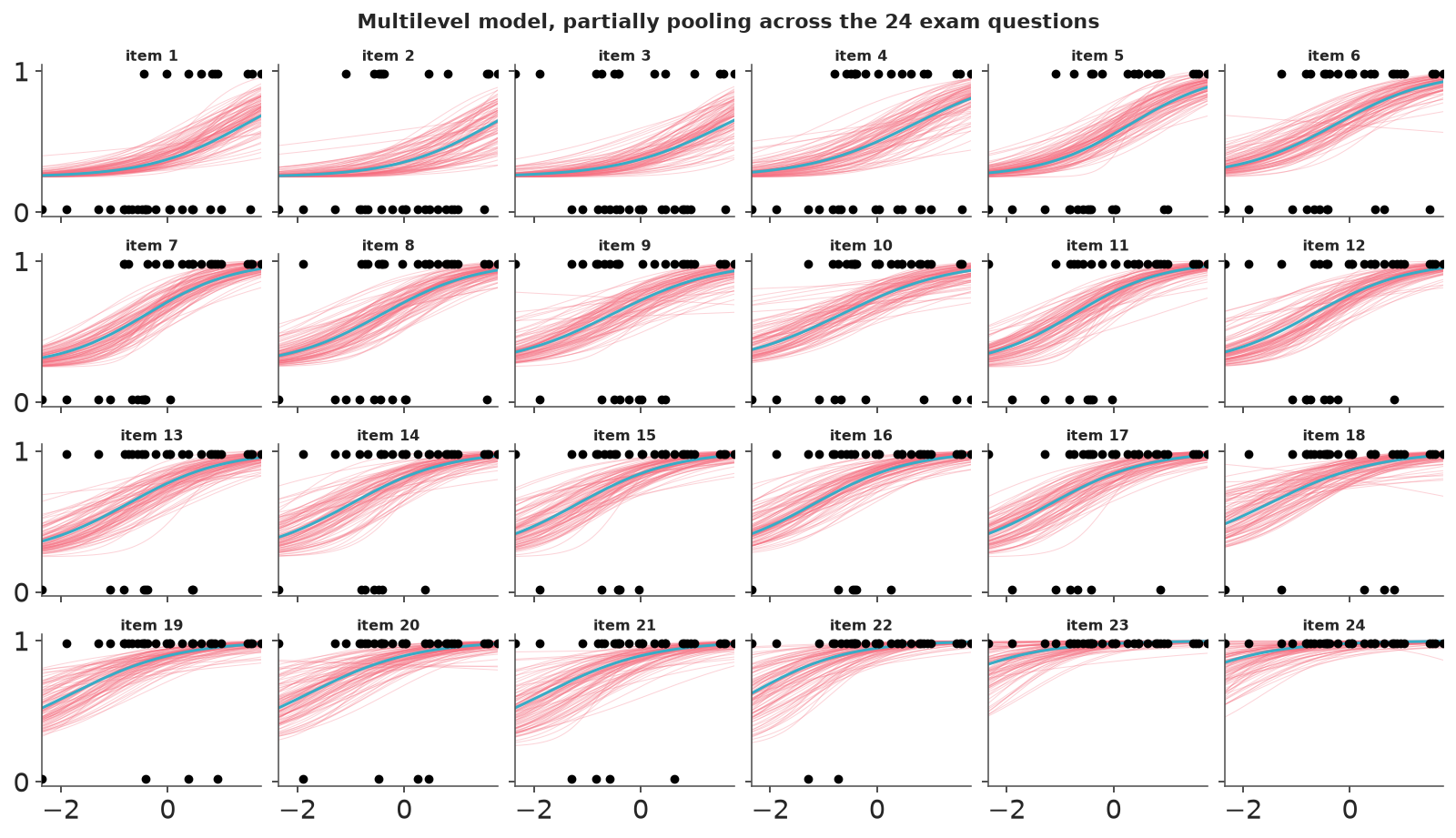
```{python}
#| label: fig-final_exams_5
plot_logit_grid_2(
    dt_5,
    "Multilevel model, partially pooling across the 24 exam questions",
    "Standardized exam score",
    score_adj_jitt,
    longdata["y"],
    longdata["item"],
    item_id,
    guessprob=0.25
)

az.summary(dt_5, var_names=["mu_a", "sigma_a", "mu_b", "sigma_b"])
```
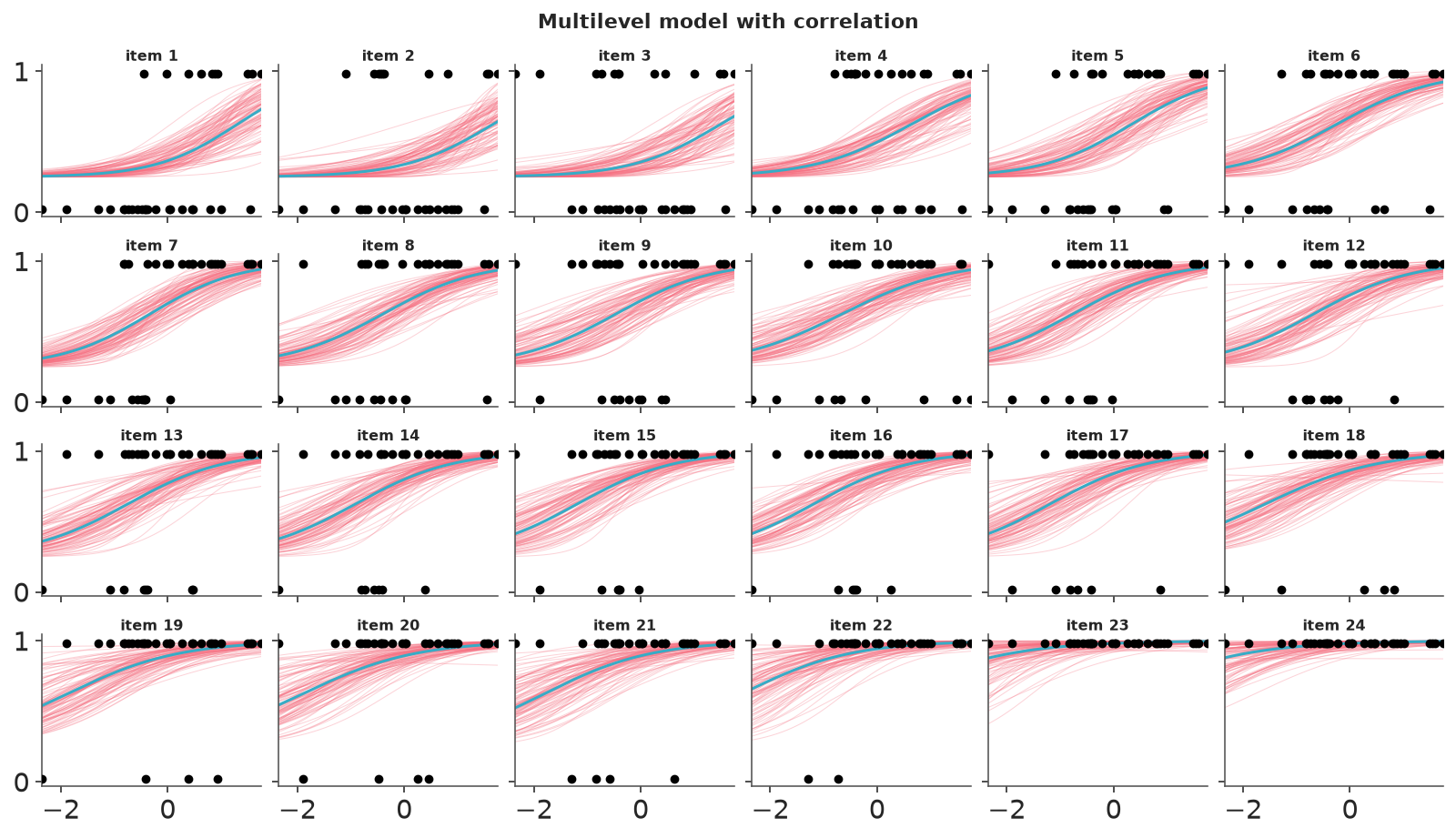
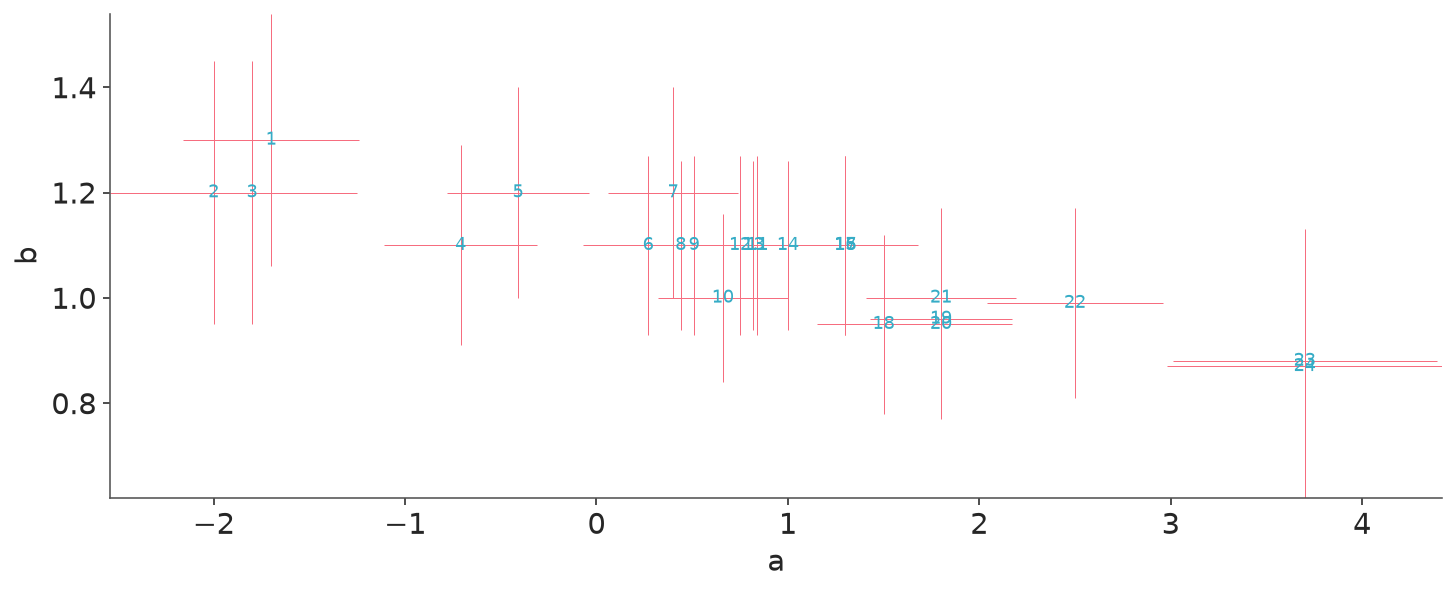
### Multilevel model with correlation
```{python}
print_stan(logit_guessing_multilevel_bivariate)
```
```{python}
#| label: fig-final_exams_6
longdata_6 = {
    **longdata,
    "mu_mu_ab": [0, 0],
    "sigma_mu_ab": [5, 10],
    "mu_sigma_ab": [5, 10]
}
dt_6 = az.from_cmdstanpy(logit_guessing_multilevel_bivariate.sample(data=longdata_6, show_progress=False))
plot_logit_grid_2(
    dt_6,
    "Multilevel model with correlation",
    "Standardized exam score",
    score_adj_jitt,
    longdata["y"],
    longdata["item"],
    item_id,
    guessprob=0.25
)
az.summary(dt_6, var_names=["mu_ab", "sigma_ab", "Omega_ab"])
```
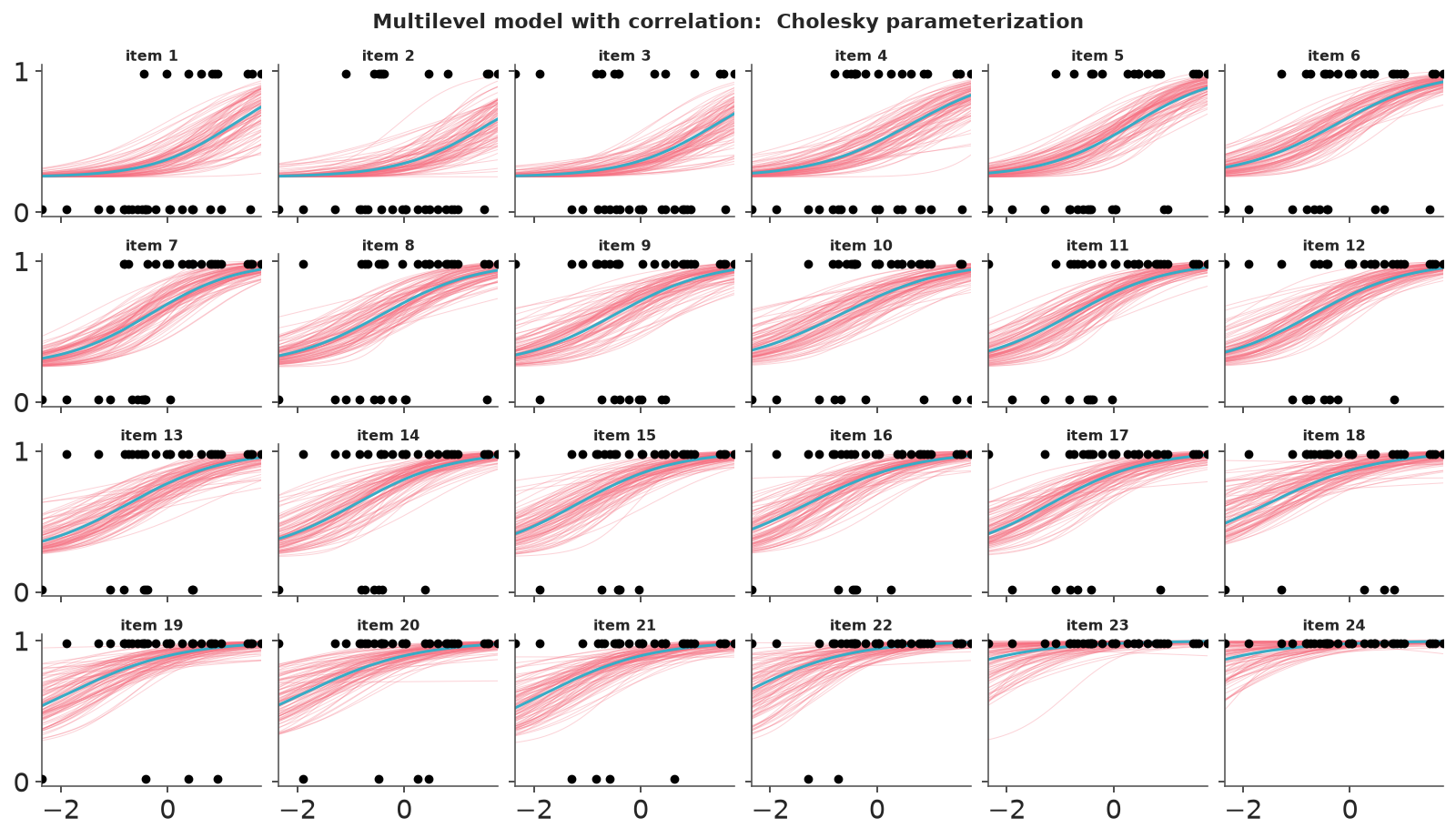
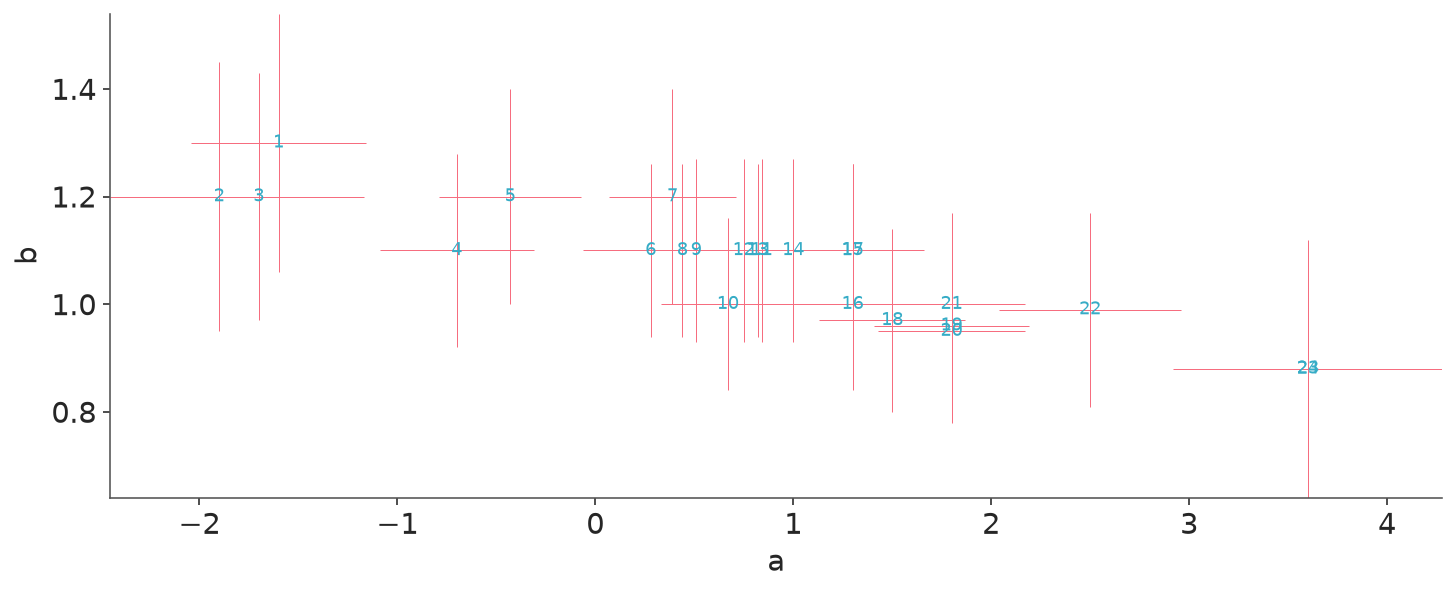
### Multilevel model with correlation using Cholesky
```{python}
print_stan(logit_guessing_multilevel_bivariate_cholesky)
```
```{python}
#| label: fig-final_exams_7
longdata_7 = {
    **longdata,
    "mu_mu_ab": [0, 0],
    "sigma_mu_ab": [5, 10],
    "mu_sigma_ab": [5, 10]
}
dt_7 = az.from_cmdstanpy(logit_guessing_multilevel_bivariate_cholesky.sample(data=longdata_7, show_progress=False))
plot_logit_grid_2(
    dt_7,
    "Multilevel model with correlation:  Cholesky parameterization",
    "Standardized exam score",
    score_adj_jitt,
    longdata["y"],
    longdata["item"],
    item_id,
    guessprob=0.25
)
az.summary(dt_7, var_names=["mu_ab", "sigma_ab", "Omega_ab"])
```
## Item-response theory (IRT) models
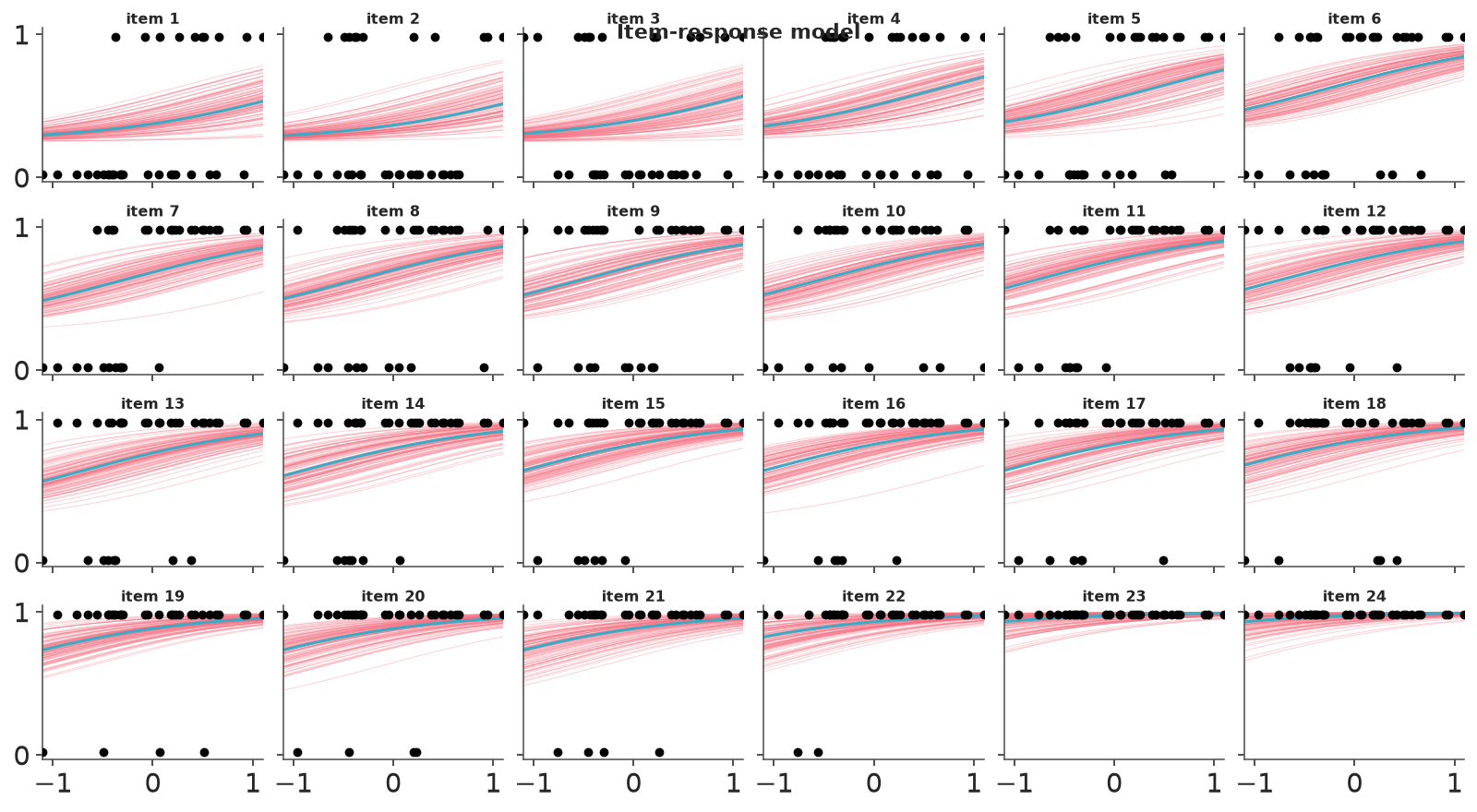
### Item-response model
```{python}
print_stan(irt_guessing)
```
```{python}
#| label: fig-final_exams_11
irt_data_11 = {
    **longdata,
    "mu_mu_beta": 0, "sigma_mu_beta": 5,
    "mu_sigma_alpha": 5, "mu_sigma_beta": 5
}
dt_11 = az.from_cmdstanpy(irt_guessing.sample(data=irt_data_11, inits=2, show_progress=False))
plot_irt(
    dt_11,
    "Item-response model",
    longdata["y"],
    longdata["item"],
    item_id,
    guessprob=0.25
)
```
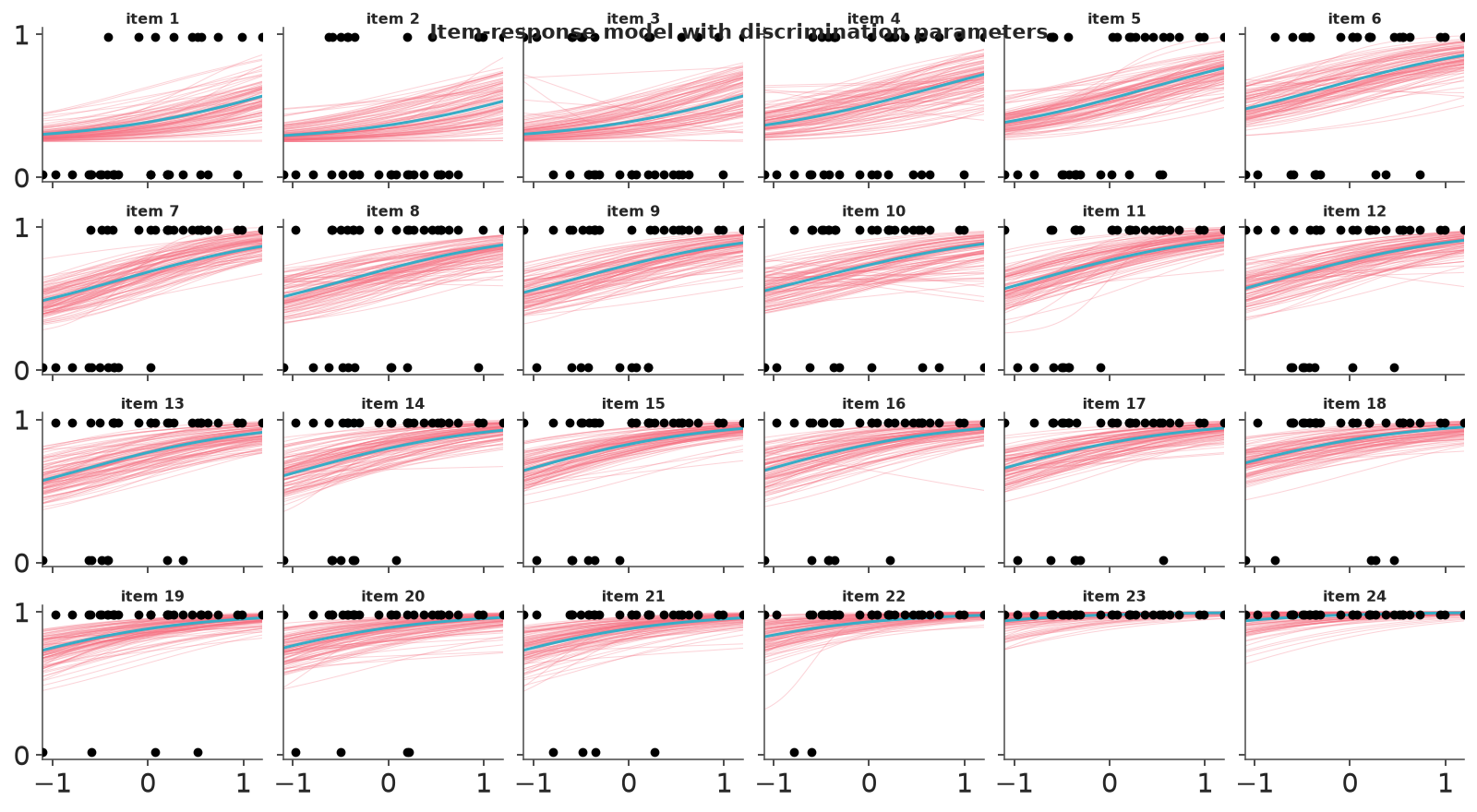
### Item-response model with discrimination parameters
```{python}
print_stan(irt_guessing_discrimination)
```
```{python}
#| label: fig-final_exams_12
irt_data_12 = {
    **longdata,
    "mu_mu_beta": 0, "sigma_mu_beta": 5,
    "mu_sigma_alpha": 5, "mu_sigma_beta": 5,
    "mu_sigma_gamma": 0.5
}
dt_12 = az.from_cmdstanpy(irt_guessing_discrimination.sample(data=irt_data_12, inits=2, show_progress=False))
plot_irt(
    dt_12,
    "Item-response model with discrimination parameters",
    longdata["y"],
    longdata["item"],
    item_id,
    guessprob=0.25
)
```
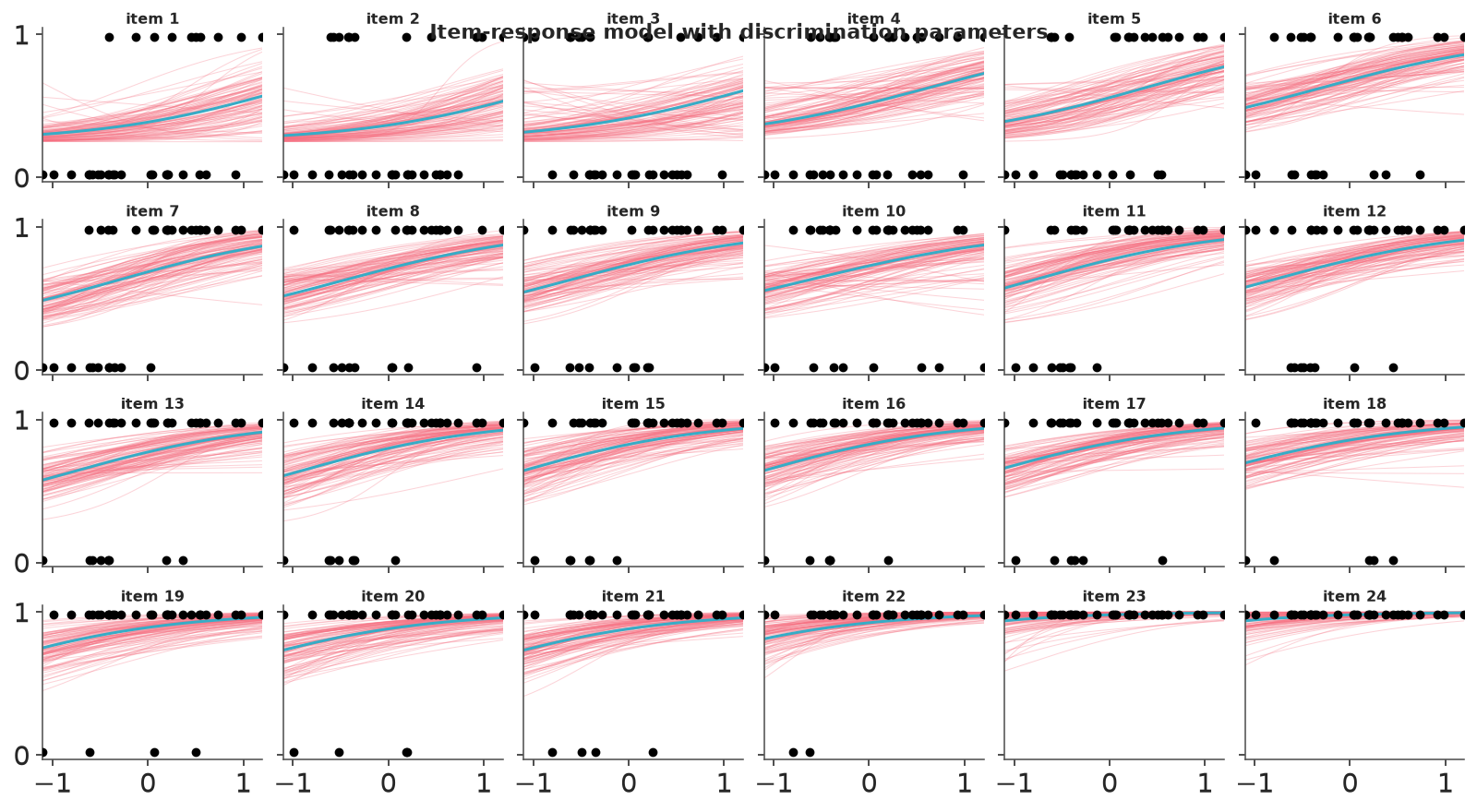
### Item-response model with discrimination parameters with init
```{python}
#| label: fig-final_exams_13
irt_data_13 = {
    **longdata,
    "mu_mu_beta": 0, "sigma_mu_beta": 5,
    "mu_sigma_alpha": 5, "mu_sigma_beta": 5,
    "mu_sigma_gamma": 0.5
}
dt_13 = az.from_cmdstanpy(irt_guessing_discrimination.sample(data=irt_data_13, inits=0.1, show_progress=False))
plot_irt(
    dt_13,
    "Item-response model with discrimination parameters",
    longdata["y"],
    longdata["item"],
    item_id,
    guessprob=0.25
)
```
IRT plots
```{python}
posterior = az.extract(dt_13, group="posterior")
alpha_sims = posterior["alpha"].values
beta_sims = posterior["beta"].values
gamma_sims = posterior["gamma"].values

from scipy.stats import median_abs_deviation

alpha_hat = np.median(alpha_sims, axis=1)
alpha_sd = median_abs_deviation(alpha_sims, axis=1, scale="normal")
beta_hat = np.median(beta_sims, axis=1)
beta_sd = median_abs_deviation(beta_sims, axis=1, scale="normal")
gamma_hat = np.median(gamma_sims, axis=1)
gamma_sd = median_abs_deviation(gamma_sims, axis=1, scale="normal")
```
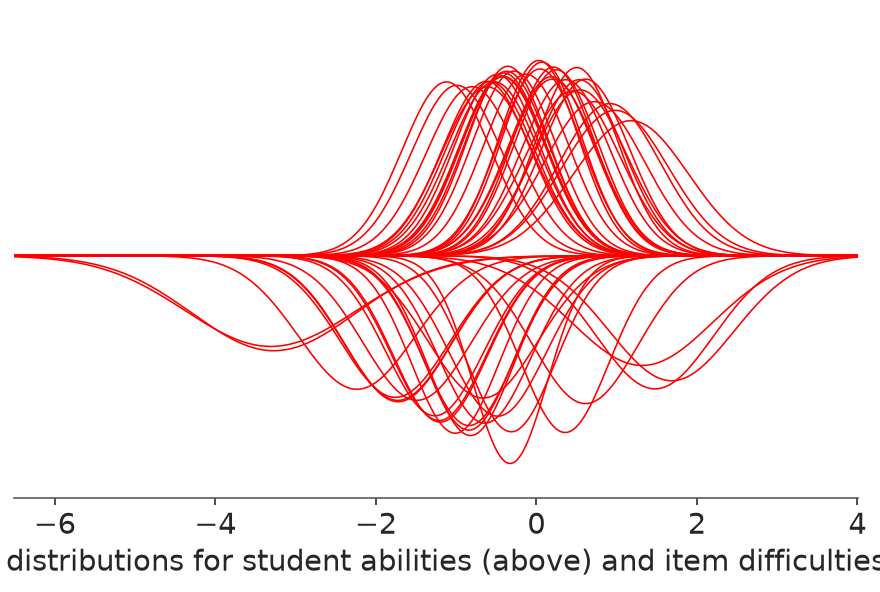
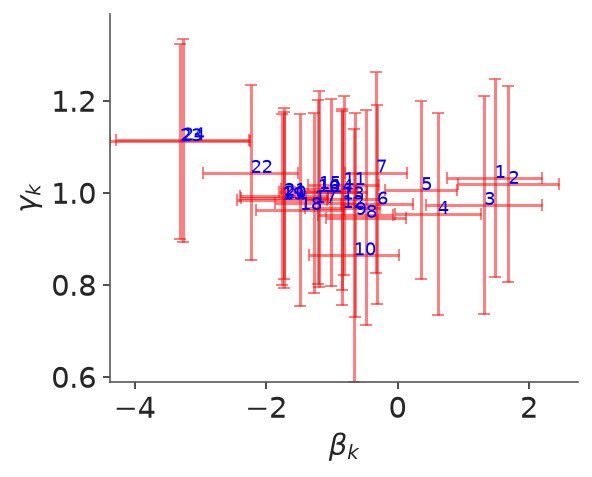
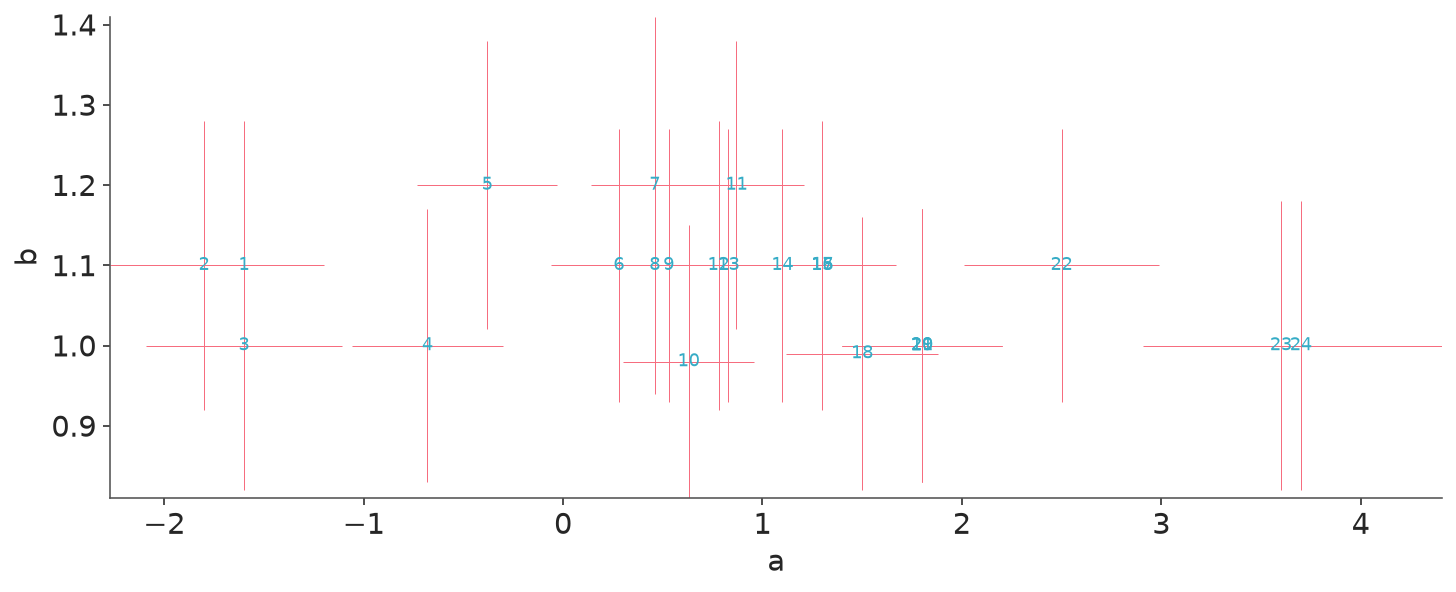
```{python}
#| label: fig-irt_displays_1
from scipy.stats import norm

rng_lo = min(np.min(alpha_hat - 3*alpha_sd), np.min(beta_hat - 3*beta_sd))
rng_hi = max(np.max(alpha_hat + 3*alpha_sd), np.max(beta_hat + 3*beta_sd))
x_range = np.linspace(rng_lo, rng_hi, 300)

fig, ax = plt.subplots(figsize=(6, 4))
ax.set_xlim(rng_lo, rng_hi)
ax.set_ylim(-1, 1)
ax.set_xlabel("Posterior distributions for student abilities (above) and item difficulties (below)")
ax.set_yticks([])
ax.spines[["top", "right", "left"]].set_visible(False)

# Student abilities (Gaussian curves above the axis)
for j in range(J):
    ax.plot(x_range, norm.pdf(x_range, alpha_hat[j], alpha_sd[j]), color="red", lw=0.8)

# Item difficulties (Gaussian curves below the axis)
for k in range(K):
    ax.plot(x_range, -norm.pdf(x_range, beta_hat[k], beta_sd[k]), color="red", lw=0.8)
```
```{python}
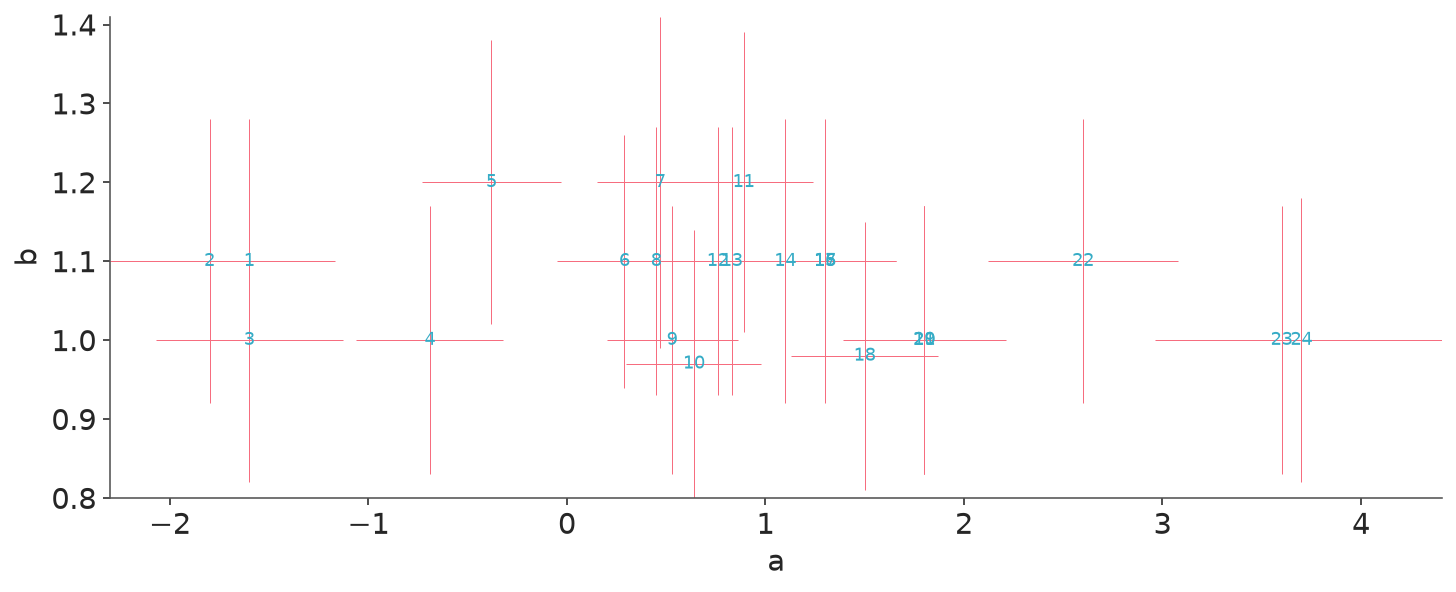
#| label: fig-irt_displays_2
x_rng = [beta_hat.min() - beta_sd.max(), beta_hat.max() + beta_sd.max()]
y_rng = [gamma_hat.min() - gamma_sd.max(), gamma_hat.max() + gamma_sd.max()]

fig, ax = plt.subplots(figsize=(4, 3.2))
ax.set_xlim(x_rng[0], x_rng[1])
ax.set_ylim(y_rng[0], y_rng[1])
ax.set_xlabel(r"$\beta_k$")
ax.set_ylabel(r"$\gamma_k$")
ax.spines[["top", "right"]].set_visible(False)

for k in range(K):
    ax.errorbar(beta_hat[k], gamma_hat[k], xerr=beta_sd[k], yerr=gamma_sd[k],
               fmt='none', color='red', alpha=0.5, capsize=3)
    ax.text(beta_hat[k], gamma_hat[k], str(item_id[k]), color='blue', fontsize=9)
```
## Prior predictive simulations
```{python}
def prior_predictive(x, x_jitt, mu_a, sigma_a, mu_b, sigma_b, seed=None):
    """Generate prior predictive simulation"""
    if seed is not None:
        np.random.seed(seed)

    a = np.random.normal(mu_a, sigma_a)
    b = np.random.normal(mu_b, sigma_b)
    y = np.random.binomial(1, expit(a + b * x))

    fig, ax = plt.subplots(figsize=(7.5, 2.5))
    ax.set_xlim(x.min() - 0.5, x.max() + 0.5)
    ax.set_ylim(0, 1)
    ax.set_xlabel("x")
    ax.set_ylabel("y")
    ax.set_xticks(np.arange(-2, 3, 1))
    ax.set_yticks([0, 1])
    ax.spines[["top", "right"]].set_visible(False)

    y_jitter = 0.5 + 0.96 * (y - 0.5)
    ax.scatter(x_jitt, y_jitter, s=20, color="blue", alpha=0.7)

    return fig, ax
```
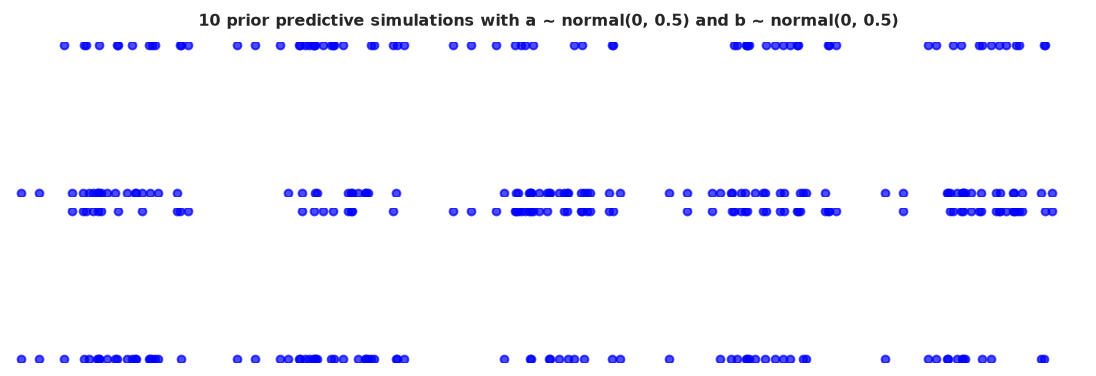
```{python}
#| label: fig-multiplechoice_prior_predictive_1
fig, axes = plt.subplots(2, 5, figsize=(7.5, 2.5))
axes = axes.flatten()

for i in range(10):
    np.random.seed(SEED + i)
    a = np.random.normal(0, 0.5)
    b = np.random.normal(0, 0.5)
    y = np.random.binomial(1, expit(a + b * score_adj))

    ax = axes[i]
    ax.set_xlim(-2.5, 2.5)
    ax.set_ylim(0, 1)
    ax.set_xticks([])
    ax.set_yticks([])
    ax.spines[["top", "right", "left", "bottom"]].set_visible(False)

    y_jitter = 0.5 + 0.96 * (y - 0.5)
    ax.scatter(score_adj_jitt, y_jitter, s=15, color="blue", alpha=0.7)

fig.suptitle("10 prior predictive simulations with a ~ normal(0, 0.5) and b ~ normal(0, 0.5)", fontsize=8)
```
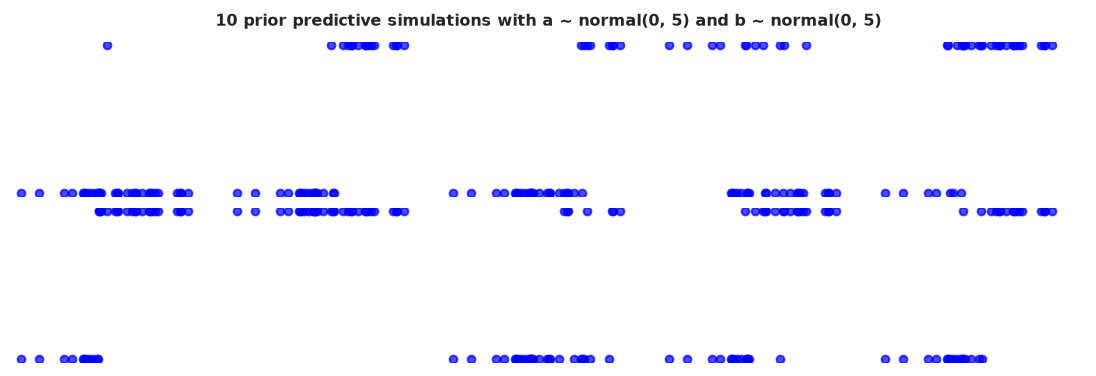
```{python}
#| label: fig-multiplechoice_prior_predictive_2
fig, axes = plt.subplots(2, 5, figsize=(7.5, 2.5))
axes = axes.flatten()

for i in range(10):
    np.random.seed(SEED + 10 + i)
    a = np.random.normal(0, 5)
    b = np.random.normal(0, 5)
    y = np.random.binomial(1, expit(a + b * score_adj))

    ax = axes[i]
    ax.set_xlim(-2.5, 2.5)
    ax.set_ylim(0, 1)
    ax.set_xticks([])
    ax.set_yticks([])
    ax.spines[["top", "right", "left", "bottom"]].set_visible(False)

    y_jitter = 0.5 + 0.96 * (y - 0.5)
    ax.scatter(score_adj_jitt, y_jitter, s=15, color="blue", alpha=0.7)

fig.suptitle("10 prior predictive simulations with a ~ normal(0, 5) and b ~ normal(0, 5)", fontsize=8)
```
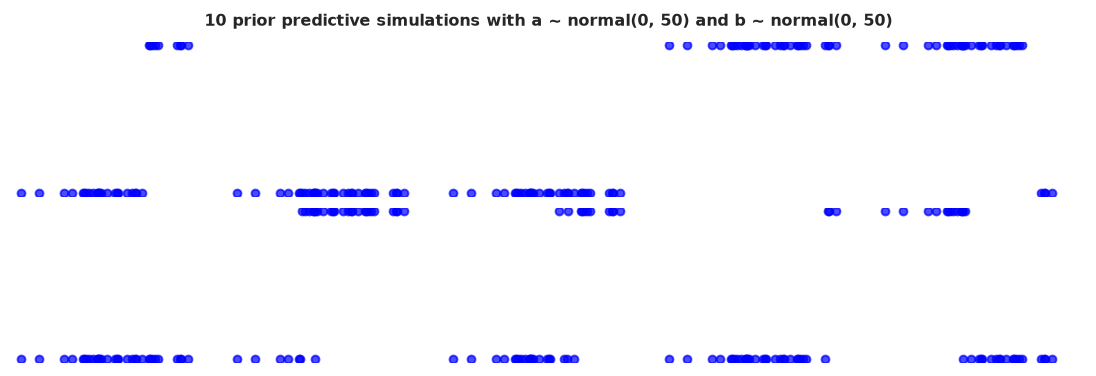
```{python}
#| label: fig-multiplechoice_prior_predictive_3
fig, axes = plt.subplots(2, 5, figsize=(7.5, 2.5))
axes = axes.flatten()

for i in range(10):
    np.random.seed(SEED + 20 + i)
    a = np.random.normal(0, 50)
    b = np.random.normal(0, 50)
    y = np.random.binomial(1, expit(a + b * score_adj))

    ax = axes[i]
    ax.set_xlim(-2.5, 2.5)
    ax.set_ylim(0, 1)
    ax.set_xticks([])
    ax.set_yticks([])
    ax.spines[["top", "right", "left", "bottom"]].set_visible(False)

    y_jitter = 0.5 + 0.96 * (y - 0.5)
    ax.scatter(score_adj_jitt, y_jitter, s=15, color="blue", alpha=0.7)

fig.suptitle("10 prior predictive simulations with a ~ normal(0, 50) and b ~ normal(0, 50)", fontsize=8)
```
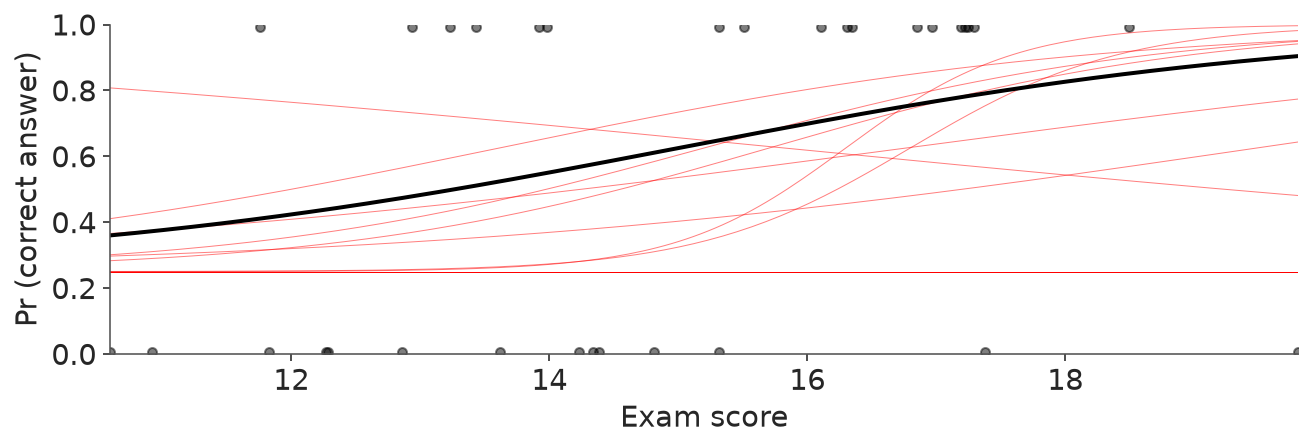
## Breaking the model
```{python}
print_stan(logit_guessing_uncentered)
```
Simulate data
```{python}
np.random.seed(123)
J_break = 32
x_break = np.random.uniform(10, 20, J_break)
a_ = -6
b_ = 0.4
y_break = np.random.binomial(1, 0.25 + 0.75 * expit(a_ + b_ * x_break))

m_x = x_break.mean()
s_x = x_break.std()
x_adj_break = (x_break - m_x) / s_x

break_data = {
    "J": J_break,
    "x": x_break.tolist(),
    "y": y_break.tolist(),
    "mu_a": 0,
    "sigma_a": 1000,
    "mu_b": 0,
    "sigma_b": 1000
}
```
```{python}
#| results: hide
break_1_fit = logit_guessing_uncentered.sample(data=break_data, show_progress=False)
```
```{python}
posterior = az.extract(az.from_cmdstanpy(break_1_fit), group="posterior")
a_break = posterior["a"].values.flatten()
b_break = posterior["b"].values.flatten()
n_sims = len(a_break)
```
```{python}
#| label: fig-break_1
fig, ax = plt.subplots(figsize=(9, 3))
ax.set_xlim(x_break.min(), x_break.max())
ax.set_ylim(0, 1)
ax.set_xlabel("Exam score")
ax.set_ylabel("Pr (correct answer)")
ax.spines[["top", "right"]].set_visible(False)

x_line = np.linspace(x_break.min() - 1, x_break.max() + 1, 200)

for s in np.random.choice(n_sims, size=min(20, n_sims), replace=False):
    y_line = 0.25 + 0.75 * expit(a_break[s] + b_break[s] * x_line)
    ax.plot(x_line, y_line, color="red", alpha=0.5, linewidth=0.5)

y_true = 0.25 + 0.75 * expit(a_ + b_ * x_line)
ax.plot(x_line, y_true, color="black", linewidth=2)

y_jitter = 0.5 + 0.985 * (y_break - 0.5)
ax.scatter(x_break, y_jitter, s=20, color="black", alpha=0.5)
```
```{python}
#| results: hide
break_2_fit = logit_guessing.sample(data=break_data, show_progress=False)
print(break_2_fit)
```
```{python}
posterior = az.extract(az.from_cmdstanpy(break_2_fit), group="posterior")
a_break = posterior["a"].values.flatten()
b_break = posterior["b"].values.flatten()
n_sims = len(a_break)
```
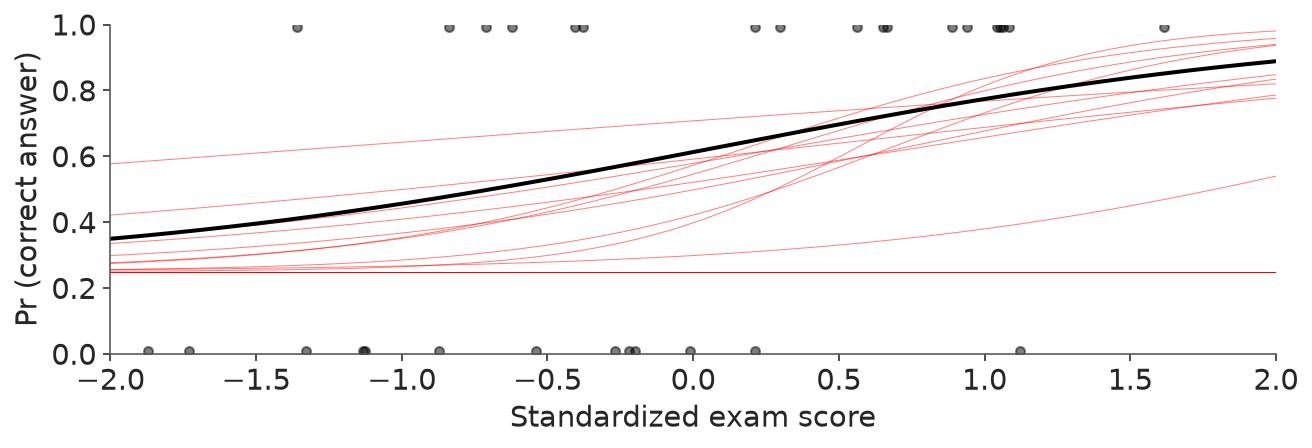
```{python}
#| label: fig-break_2
fig, ax = plt.subplots(figsize=(9, 3))
ax.set_xlim(-2, 2)
ax.set_ylim(0, 1)
ax.set_xlabel("Standardized exam score")
ax.set_ylabel("Pr (correct answer)")
ax.spines[["top", "right"]].set_visible(False)

x_line = np.linspace(-2.5, 2.5, 200)

for s in np.random.choice(n_sims, size=min(20, n_sims), replace=False):
    y_line = 0.25 + 0.75 * expit(a_break[s] + b_break[s] * x_line)
    ax.plot(x_line, y_line, color="red", alpha=0.5, linewidth=0.5)

y_true = 0.25 + 0.75 * expit(a_ + b_ * (m_x + s_x * x_line))
ax.plot(x_line, y_true, color="black", linewidth=2)

y_jitter = 0.5 + 0.985 * (y_break - 0.5)
ax.scatter(x_adj_break, y_jitter, s=20, color="black", alpha=0.5)
```
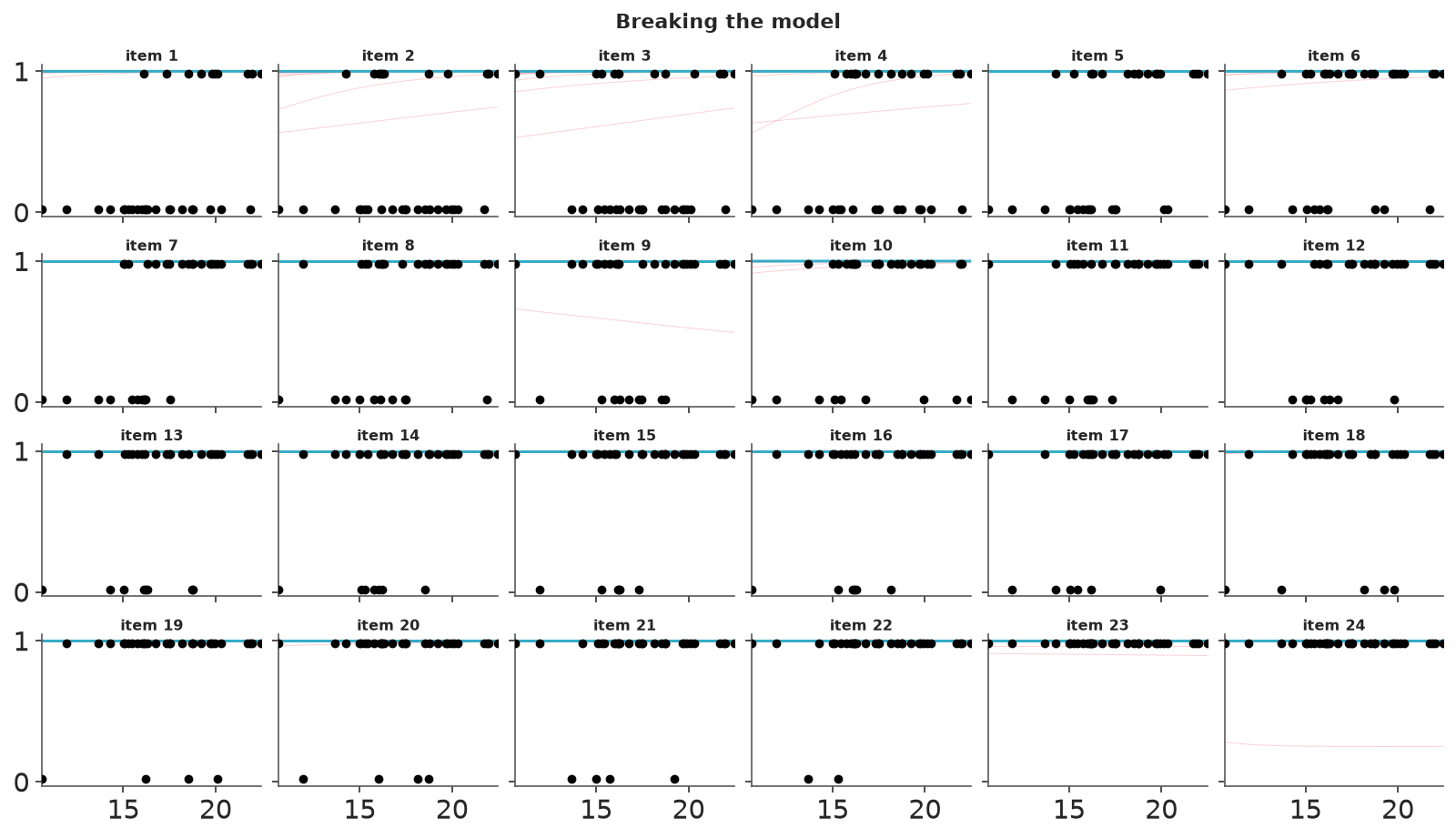
```{python}
#| label: fig-final_exams_break_1
longdata_break = {
    **longdata,
    "mu_mu_a": 0, "sigma_mu_a": 5,
    "mu_mu_b": 0, "sigma_mu_b": 5,
    "mu_sigma_a": 5, "mu_sigma_b": 5
}
dt_break = az.from_cmdstanpy(logit_guessing_multilevel.sample(data=longdata_break, show_progress=False))
plot_logit_grid_2(
    dt_break,
    "Breaking the model",
    "Exam score",
    score_jitt,
    longdata["y"],
    longdata["item"],
    item_id,
    guessprob=0.25
)
```
## References {.unnumbered}
<div id="refs"></div>
## Licenses {.unnumbered}
* Code © 2022--2025, Andrew Gelman, licensed under BSD-3.
* Text © 2022--2025, Andrew Gelman, licensed under CC-BY-NC 4.0.